
If you’ve ever wondered where the bible came from and why it is considered reliable, here’s a good place to start. Since we recently talked about the New Testament, this is a mid-week re-post about the origins of the Jewish/Christian Old Testament.
Last week we considered the Bible from a non-spiritual standpoint, evaluating it as if it were merely a system that was developed to guide human behavior (that is, a “moral” system). We found that objectively, the Bible offers a superior guide to human behavior than other “holy books” and one that is much superior to any “individual morality” that individuals choose for themselves. This week I want to dig more deeply into the origins of the Bible. This will help us to evaluate spurious claims like those of the “DaVinci Code” and the “Judas gospels” (which were touted by National Geographic last year). For now, we’ll just consider the Old Testament. We will tackle the New Testament later in the series.
Several early portions of the Old Testament were originally recited orally and passed down from generation to generation through memorization and repetition. Most of Genesis, as well as probably Ruth and Judges were all originally spoken, rather than written. How do we know this? Well, the first portions of Genesis, if accurate at all, took place before reading and writing was widespread. But even more than that, examining the Bible texts in Hebrew (which was the original language) shows several easily recognized mnemonic devices (that is, verbal cues used to help people memorize a recitation). One way to picture it this: those texts which were originally recited orally, look (at least in Hebrew) more like a play than a novel. Usually, these little memory points are lost in translation to English, but one passage in which the NIV has preserved them fairly well is Genesis 5:1-31. There are seven small sections in these verses. Each section begins with “When [somebody’s name] had lived [a number] of years…” and then some details about that person and his descendants. The section closes with “and then he died.”
If this is the first time you have heard of that, this may make you a bit uncertain about how reliable those portions of scripture could be. This is because our culture has mostly lost the art and practice of memorization. But the fact is, there used to be professional oral historians. These were people who were responsible to memorize the oral histories, word for word and teach them to the next generation. Not only that, but in the case of the Hebrew people and the Old Testament, every father had a duty to teach the spiritual history to his children. People are capable of remembering a great deal. The philosopher Socrates, who lived almost a thousand years after the time of Moses, lamented the fact that during his lifetime the Greeks started writing things down in books. He felt that if books came into widespread use, people would stop remembering things, because they would be able to simply look them up in a book. He felt memorization was a much superior way to preserve knowledge for future generations.
Even in the twentieth century, Michail Gorbachev memorized the entire text of all four gospels when he was a child. We remember more, and better, than we realize. If you have seen the movie “Monty Python and the Holy Grail” I bet you can fill in this blank: “I’m not quite ______ yet.” If you have seen the movie “The Princess Bride” I bet you know the special phrase that Wesley says to Princess Buttercup. It has three words. These are things we memorize – word for word – without even trying. How much more are people capable of in a culture where oral history is valued and practiced!
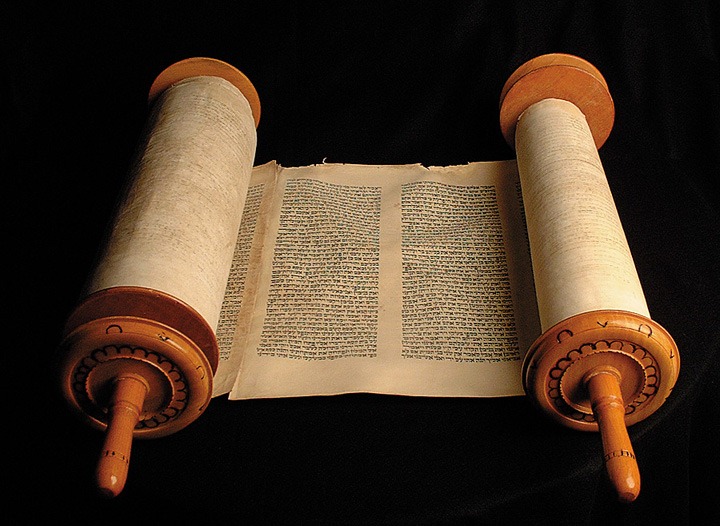
Aside from the oral histories, other parts of the Old Testament were written down, more or less at the time the events occurred or the words were spoken. The first five books of the Old Testament are called the Pentateuch; they are also known by Jews as the “Torah,” or “Law.” Over time the Torah, and the writings of the scribes and prophets were compiled into what today we call the Old Testament. We don’t know the exact date at which the Old Testament was considered to be “closed,” but it is probably around 250 B.C.E, which is the approximate date most scholars agree that the Old Testament was first translated into Greek (the ancient Greek version of the Old Testament is called the Septuagint). We don’t have any original copies of the Old Testament. Professional scribes carefully copied the originals when they became worn, and then destroyed the originals. When the copies became worn, new copies were made and the older copies destroyed. For many years, the oldest copy that had been found was made in the 800s A.D. — much newer, in fact, than many New Testament manuscripts. Because of this, many scholars assumed that if the Old Testament manuscript copies were compared to the originals, there would be many errors. However, it should be noted that later manuscripts agree very closely with these earliest texts, which shows that the scribes took great care when making copies. In 1947, the “Dead Sea Scrolls” were discovered. These are not all Biblical writings, but among them are parts of the Old Testament. The Dead Sea Scrolls date back to 1000 years before those previous Old Testament manuscripts. As it turns out, at least in the texts that are available for comparison, during those thousand years very few copying errors were made, and none were significant. Again it is an example of how carefully the Old Testament was preserved by the scribes. I have personally seen a scroll of Isaiah that was made in about 1400 AD and used in a synagogue in Germany for 400 years — until the mid-1800s, when it was taken out of use. It looked cleaner, clearer and more pristine than these sermon notes. Taken all in all, it has been demonstrated thoroughly that the contents of the Old Testament have been preserved, largely unchanged, from when they originated.
Now, in spite of these well-preserved texts, there is a prevalent and long-standing tendency to discount the Old Testament as “religious writing” and therefore inaccurate. For many decades the trendy thing was to doubt everything the Bible said – even the “normal, historical” parts of it – unless it could be confirmed by some sort of archaeological discovery. For instance, until very recently, Skeptical scholars claimed that king David of Israel was a mythical figure who had been made up by the writers of the Bible. Unfortunately for them, archaeologists discovered a reference to David in the writings of another culture in the middle east. The reference to David matched the approximate time period that the Bible puts him in.
In the Old Testament, Isaiah writes about the invasion of the Assyrian army. He describes how they laid siege to the town of Lacish, and then how they came and surrounded Jerusalem. He mentioned Sennacherib, the Assyrian emperor at the time. Over where Assyria used to be, they have uncovered some of the records and court commissioned art from the time of Sennacherib. We shouldn’t be surprised to learn that the Assyrians recorded some of the same events, and even mentioned the name of Hezekiah, King of Judah at the time, according to the Bible.
According to the Old Testament, the Israelites destroyed the town of Jericho in about 1400 BCE. According to archaeologists, Jericho was indeed destroyed about 1400 BCE. There is not enough time and space to describe all of the archaeological discoveries which have, over and over, proven that the Bible is a reliable historical source. The people it talks about were real people; the situations it describes were real. The history it records really happened. The texts were truly written or memorized when the events they record were actually happening.
Millar Burrows, a PhD graduate of Yale University, and one of the leading authorities on the Dead Sea Scrolls, said this:
The Bible is supported by archaeological evidence again and again. On the whole, there can be no question that the results of excavation have increased the respect of scholars for the Bible as a collection of historical documents. The confirmation is both general and specific. The fact that the record can be soften explained or illustrated by archaeological data shows that if fits into the framework of history as only a genuine product of ancient life could do. In addition to this general authentication, however, we find the record verified repeatedly as specific points. Name of places and persons turn up at the right places and in the right periods.
What is strange is that some people persist in doubting the Bible until is proven by some non-Biblical source. The truth is, there is no non-biblical source that has been so thoroughly verified as the Bible itself. It is, without question, the best documentary record of life and history in the ancient middle east.
It seems to me that people are inclined to doubt the Bible because, in addition to history, the bible contains records of supernatural activity. It doesn’t just talk about kings and wars – it also talks about miracles, healings and God’s standards. It’s commonly thought that people who believe in miracles do so because their faith-system requires them to, while people who don’t believe in miracles are merely looking at the evidence. But in fact, the opposite is true. Everyone believes the Bible when it talks about a war. Why don’t some people believe it when it talks about a miracle? Because some people are inclined to disbelieve in miracles, whatever the evidence may say.
Let’s consider it from another angle. Do you believe in murders? I would guess that 100% of adults reading this, believe that murders happen. Have you ever seen a murder personally? I would guess most of us have not. Have you ever known anyone, personally, who was murdered? Again, I would guess that most of us have not. Why then, do we believe in murders? Because of the testimony of other people. Some murder testimony is written – we might see it in the newspaper. Other testimony is spoken – someone tells us about it. People write stories and TV shows about murder.
There is nearly as much written and spoken testimony throughout history about miracles as there is about murder. If a man tells us of a murder, we tend to believe it. If he tells us about a miracle, many people tend to not believe it. Why not? Because they already have a belief against miracles. They may say, “Ah, but the people telling us about miracles are unreliable. We can’t trust them, because they are biased.” The problem with that is, they would trust them if they were telling about a murder. In other words they believe in murder, so they accept what people say about it. If you don’t believe in miracles, it really doesn’t matter what anyone says – you won’t believe it. In fact, the only reason you think someone telling you about miracle is unreliable, is because you start off by not believing in miracles.
To put it simply: the reason to believe in miracles is because there is so much evidence for them. The reason not to believe in them, is because you are already starting with a belief that they don’t happen.
So it is with the Bible. We know that the texts and contents have been preserved accurately, reliably and authentically. It has been proven reliable in how it records history. We we know we can believe it when it tells us that King Sennacherib invaded Judah. The natural, objective approach would be to believe it also when it tells us of God and the supernatural.
Psalm 119:97-103 says this:
97 Oh, how I love your law!
I meditate on it all day long.
98 Your commands make me wiser than my enemies,
for they are ever with me.
99 I have more insight than all my teachers,
for I meditate on your statutes.
100 I have more understanding than the elders,
for I obey your precepts.
101 I have kept my feet from every evil path
so that I might obey your word.
102 I have not departed from your laws,
for you yourself have taught me.
103 How sweet are your words to my taste,
sweeter than honey to my mouth!
~
I want to briefly make you aware of our situation. This ministry (Clear Bible) until recently was supported by our local church. However, we have had some changes there, and we are now a house church. Today, we have about 8 families. Our church cannot fully support me financially any longer.
In contrast, about 430 people subscribe to this blog, and an additional 300 or so each week come and visit the site. In other words, by far, most of the people who benefit from this ministry are not part of our little church.
I’m asking you internet readers/listeners to pray for us. Seriously, before you give any financial support, please give us some prayer support. I value that more than anything else. Pray for this ministry to touch lives. Pray also for financial provision for my family and me.
But then, as you pray, do ask the Lord if he wants you to give financially as well. Be assured, after a small fee to Paypal, 100% of your donations will go to help support my family and me in ministry. In turn, supporting this blog means that you are helping to bless more than 15,000 people each year who visit this blog.
Some of you may have noticed that I am also a novelist. Often, people have misconceptions about authors. Most of us, including me, make a part-time income through writing, and no more. In other words, we aren’t “raking it in” somewhere else. Now, we trust the Lord to provide, and I don’t want you to give out of guilt or fear. I just don’t want you to get the idea that your donations will only be an “extra” for us somehow.
If most of our subscribers gave just five or ten dollars each month, (or even less, if everyone pitched in) we would be in good shape. It’s easy to set up a recurring donation when you click the Paypal donate button that is located on the right hand side of this page, down just a little ways.
You could also send a check to:
New Joy Fellowship
625 Spring Creek Road
Lebanon, TN 37087
Your check will be tax-deductible. Unfortunately, we cannot do the tax deductible option with the paypal donate button, however the money does go directly to support my family and me.
Thank for your prayers, and your support!
 Clear Bible